

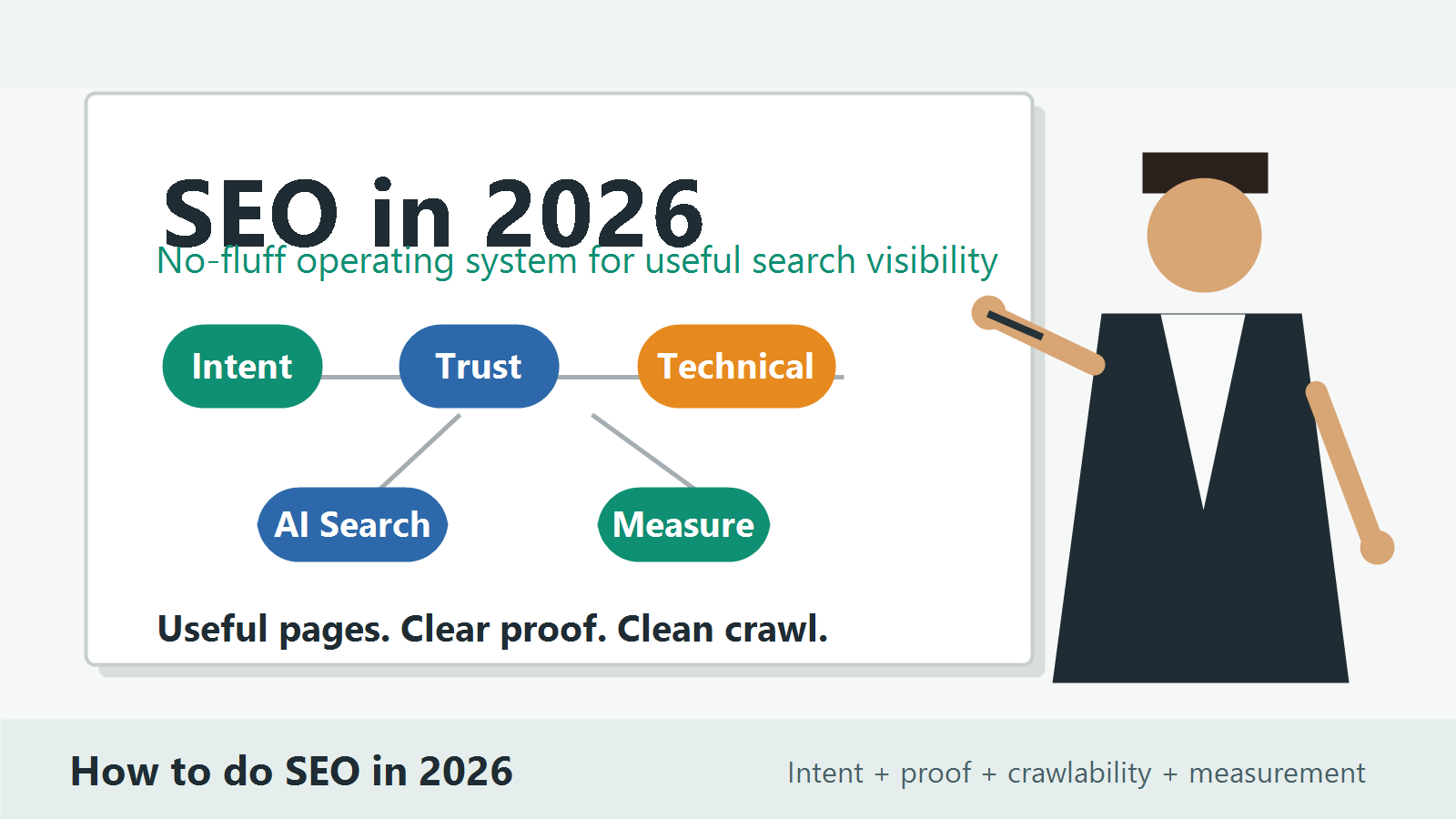
SEO in 2026 is a practical operating system, not a bag of tricks. The work is to understand what people are trying to do, build pages that solve those jobs better than generic content, make the site technically easy to crawl, and keep improving from Search Console evidence.
This guide is written for business owners, marketers, and content teams who need a working SEO process. It covers what to do and how to do it: page planning, content structure, AI Search, technical checks, internal linking, schema, trust signals, and measurement.
The Short Version
If you only remember one thing, remember this: every important page needs a clear job, a useful answer, proof that the answer can be trusted, and a clean technical path for search engines to access it.
Use this workflow:
- Choose the business outcome for the page.
- Map the search intent and the questions behind it.
- Write the page around decisions, not keyword stuffing.
- Add proof, examples, process, or local expertise.
- Make the page crawlable, fast, canonical, and internally linked.
- Use structured data only where it matches visible content.
- Measure impressions, clicks, queries, and conversions after publishing.
- Improve the page based on evidence, not guesses.
The operating rule: build pages that solve a real search task, prove why the answer should be trusted, and make the page technically easy for search engines to crawl, interpret, and measure.
1. Start With the Business Job
Before keyword research, decide what the page must do for the business. SEO fails when every page is treated like a traffic target. A page for “SEO services” has a different job from a page for “how to fix duplicate title tags”. The first should help someone choose a provider. The second should help someone solve a problem and trust your expertise.
How to do it
Create a one-page brief before writing:
- Page type: service page, guide, comparison, case study, location page, checklist, or glossary page.
- Business outcome: lead, call, booking, newsletter sign-up, sales support, or topical authority.
- Primary searcher: owner, marketing manager, technical lead, buyer, researcher, or existing customer.
- Decision stage: learning, comparing, fixing, buying, or validating.
- Primary next action: contact, read a related guide, download a checklist, request an audit, or compare options.
Now the page has a job. That job controls the keyword set, the structure, the examples, and the call to action.
Example
A post about “how to do SEO in 2026” should not only define SEO. It should give the reader a repeatable workflow they can use this week. That means templates, checks, examples, and decision rules matter more than broad claims.
2. Map Search Intent Properly
Search intent is the reason behind the query. In 2026, this matters even more because search results can include classic links, AI Overviews, videos, forums, product blocks, maps, and other result types. If your page does not match the task, it will struggle even if the keyword appears on the page.
How to do it
For the main query, write down:
- What problem the searcher has.
- What they need to know first.
- What would make them stop searching.
- What proof they need before trusting the answer.
- What format would help most: steps, checklist, comparison, examples, table, or tutorial.
Then check the live search results manually. Look for the patterns Google is already rewarding: guides, product pages, local packs, tools, videos, news, comparisons, or forum discussions. Do not copy the results. Use them to understand the task Google thinks the query represents.
Intent matrix
| Intent | Searcher wants | Best page format |
|---|---|---|
| Informational | Understand a topic or solve a problem | Guide, tutorial, checklist, glossary |
| Commercial | Compare options before choosing | Comparison, buyer guide, case study |
| Transactional | Buy, book, request, or contact | Service page, product page, landing page |
| Local | Find a provider in a place | Location page, local service page, Google Business Profile support |
3. Build Pages Around Useful Sections
A strong SEO page is not a long wall of text. It is a sequence of useful sections that answer the reader’s next question at the right time.
How to structure a page
Use this order for most practical guides:
- Answer first: state the direct answer in the opening section.
- Context: explain what changed or why the topic matters.
- Process: give the steps in order.
- Examples: show how the process looks in practice.
- Checks: give the reader a way to verify they did it correctly.
- Common mistakes: explain what breaks the result.
- Next action: point to the logical next step.
Answer-first template
Use this paragraph pattern near the top of any guide:
To solve [problem], do [primary action]. Start by [first step], then [second step], and verify success by [measurement]. Avoid [common mistake] because it causes [bad outcome].
This works because it gives the reader the answer before asking them to read the full argument.
4. Create Non-Commodity Content
Google’s generative AI guidance is clear that useful, non-commodity content matters. Generic summaries are weak because anyone can produce them. Strong pages add something specific: experience, examples, evidence, process, data, local knowledge, or a point of view.
How to do it
For every important page, add at least three of these:
- Specific example: show a realistic before-and-after page outline.
- Decision rule: explain when to choose one option over another.
- Checklist: give a practical verification list.
- Workflow: show the order of operations.
- Original observation: explain what you see in client work or your market.
- Evidence: link to primary sources, documentation, case studies, or your own results.
Weak vs strong
| Weak content | Stronger content |
|---|---|
| “Create helpful content.” | “Interview the sales team, list the five objections buyers ask before booking, and answer each one on the service page.” |
| “Improve technical SEO.” | “Check indexability, canonical, internal links, page speed, schema validity, and rendered HTML before requesting indexing.” |
| “Optimize for AI Search.” | “Write answer-first sections, cite primary sources, add clear headings, and include original examples that an AI summary can attribute.” |
5. Optimize for AI Search Without Chasing Hype
AI Search does not replace SEO. Google’s generative AI features are rooted in core Search ranking and quality systems. That means the foundation still matters: useful content, crawlability, links, quality, and clarity.
How to do it
Make pages easier to retrieve, interpret, and cite:
- Use descriptive headings that match real questions.
- Put direct answers near the top of each section.
- Break processes into ordered steps.
- Use tables for comparisons and checklists for procedures.
- Explain terms before using jargon.
- Add examples that are specific to your audience.
- Link to primary sources when facts depend on current rules.
- Keep claims precise. Avoid “best”, “guaranteed”, and “leading” unless you prove them.
Query fan-out planning
AI systems may consider related questions around the original query. You do not need a separate page for every variation. Instead, include supporting sections that naturally answer the connected questions.
For a page about “SEO in 2026”, related sections should cover:
- Whether SEO still matters with AI Overviews.
- How to create useful content instead of commodity content.
- How technical SEO supports AI Search visibility.
- How to use structured data correctly.
- How to measure performance after publishing.
Do not publish and hope. Run the technical checks before requesting indexing, because crawl, canonical, heading, image, and metadata problems can weaken even a strong article.
6. Fix the Technical Foundation
Technical SEO is the part that makes good content accessible. It does not make weak content strong, but technical problems can stop strong content from performing.
Pre-publish technical checklist
- The page returns HTTP 200.
- The canonical points to the correct final URL.
- The page is indexable and not blocked by robots.txt.
- The title tag is unique and under control.
- The meta description is present when the theme or SEO plugin supports it.
- There is one main visible page title, followed by logical H2 and H3 sections.
- Important text appears in the HTML, not only inside images.
- Images have descriptive alt text and useful filenames.
- The page is internally linked from at least one relevant page.
- The page loads acceptably on mobile.
How to check it quickly
After publishing, run a crawler or browser audit and check the page source. Look for the title tag, canonical, robots tag, meta description, headings, image alt text, and indexability. Then inspect the URL in Google Search Console once the page is ready.
7. Use Internal Links Like a Map
Internal links tell users and crawlers which pages matter and how topics connect. Random blog posts do not build authority by sitting alone. They need to support service pages, location pages, case studies, and related guides.
How to do it
For each new post, add links in both directions:
- From the new post to the most relevant service or topic hub.
- From an existing relevant page back to the new post.
- From related supporting articles to the new post where it helps the reader.
Use descriptive anchor text. “Read our SEO services page” is clearer than “click here”. Do not force exact-match anchors everywhere. The goal is clarity, not manipulation.
8. Add Structured Data Carefully
Structured data helps search engines understand entities and page features. It does not guarantee rankings or rich results. It should describe content users can see on the page.
Good schema candidates
- Article: for editorial posts and guides.
- Organization: for business identity.
- LocalBusiness: for local service businesses with real location/service data.
- FAQPage: only when the page has visible FAQ content and follows Google’s current eligibility rules.
- HowTo: only when the page is truly a step-by-step task and the structured data matches the visible steps.
Implementation rule
Do not mark up content that is not visible. Do not use schema to exaggerate ratings, locations, services, or availability. Validate the markup before publishing and again after template changes.
Measurement is part of SEO work. If a page is not reviewed after publishing, the team is guessing instead of improving from real query, click, and conversion data.
9. Measure What Matters
Traffic alone is not the goal. A page can attract visitors who never buy. Another page can bring fewer visitors but better leads. SEO measurement should connect visibility to useful outcomes.
What to review in Search Console
- Impressions: whether Google is testing the page for relevant queries.
- Clicks: whether the title and snippet earn attention.
- Average position: whether the page is close enough to improve.
- Queries: whether the page ranks for the intent you planned.
- Pages: whether similar pages are competing with each other.
30-day improvement cycle
- Publish the page.
- Request indexing if appropriate.
- Wait for enough impressions to see query patterns.
- Find queries with high impressions and low clicks.
- Rewrite titles or intros where the promise is unclear.
- Add missing sections for queries that match the page intent.
- Build internal links from relevant existing pages.
- Update the page date only when the content materially changes.
10. Build a Repeatable SEO Operating System
One good article is useful. A repeatable system is better. Treat SEO as a monthly operating rhythm.
Weekly
- Review Search Console movement for important pages.
- Check new content for indexing and title/snippet quality.
- Add internal links from fresh content to service pages.
Monthly
- Refresh pages that lost impressions or clicks.
- Consolidate pages that target the same intent.
- Publish one useful page that supports a real service or buyer question.
- Review technical crawl issues and template problems.
Quarterly
- Audit your service page structure.
- Update proof: case studies, testimonials, process, pricing signals, and examples.
- Review topic clusters against business priorities.
- Remove or merge thin pages that do not serve a clear job.
Common SEO Mistakes in 2026
- Publishing AI summaries with no original experience or examples.
- Creating separate pages for every keyword variation.
- Ignoring technical basics while chasing AI Search tactics.
- Using schema that does not match visible content.
- Writing intros that delay the answer.
- Measuring only traffic instead of leads, assisted conversions, or qualified actions.
- Letting blog posts sit without internal links.
- Leaving old posts unchanged after Search Console shows better query opportunities.
SEO in 2026 Implementation Checklist
- Page has one clear business job.
- Search intent is documented before writing.
- Opening section answers the main question directly.
- Sections explain how to do the work, not only what matters.
- Content includes examples, templates, checklists, or evidence.
- Title tag is concise and specific.
- Meta description is configured where the site supports it.
- Canonical URL is correct.
- Page is indexable.
- Images have descriptive alt text.
- Internal links connect the page to related service and support pages.
- Structured data matches visible content.
- Search Console review is scheduled after publishing.
Bottom Line
SEO in 2026 rewards the same discipline that good marketing has always needed: know the audience, answer the real question, prove your claims, make the page technically accessible, and improve from evidence. The difference now is that generic content is easier to produce and easier to ignore. Specific, useful, well-structured pages are the advantage.
For hands-on implementation across search, paid media, and website improvements, see Whozamobi’s digital marketing services.

0 Comments